Foundations are the part of the structure where the Italian NTC 2018 code changed the way of calculating the most: they must remain in an essentially elastic range under earthquake, their sections are checked at the first-yield limit state and no longer at the classic ULS, settlements of pile groups must be assessed with pile-to-pile interaction, and the pile-soil interaction — markedly non-linear — can no longer be dismissed with a constant spring. This article explains how two GeoStru programs with hundreds of active licences in Italy, Fondazioni CA and RC-SEC, tackle exactly these points: modelling of the foundation (beams, grillages, rafts, footings, piles and micropiles) and verification of the RC sections, with the code references the checker will look for in the report.
What NTC 2018 asks of RC foundations
- Non-dissipative behaviour. Foundation structures must be designed to remain elastic: seismic internal forces come from capacity design or from analysis with a limited behaviour factor, and sections cannot rely on ductility.
- First-yield limit state. For all seismic combinations of foundation structures (and for superstructures analysed as non-dissipative, §7.2.2) the strength check is not at ULS: the resisting moment is the one in an essentially elastic range, corresponding to the lower of the curvature at steel yielding and the curvature at the concrete peak strain (0.002). It is the NTC 2018 novelty most often missing in generic section-check programs.
- Ductility (§7.4). Indirect checks (detailing: reinforcement ratios, stirrup confinement) and direct checks (curvature ductility factor μΦ from the moment-curvature diagram), for the elements that must be ductile.
- Settlements of pile groups at SLS. For the estimate of axial settlements in serviceability combinations NTC 2018 requires assessing the interaction between piles: a pile in a group settles more than the same pile alone.
- Kinematic effects. In layered soils with a strong stiffness contrast, the pile is loaded by the passage of seismic waves even without loads from the superstructure: the kinematic moment must be added to the inertial one.
Fondazioni CA: the foundation model
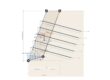
Fondazioni CA solves the foundation as a single-storey three-dimensional sway frame: the columns are the piles (also inclined), the floor is made of beams and plate fields, the soil is a bed of springs. Everything is automatically discretised into finite elements from an average mesh size, with rigid offsets for eccentricities and for the beam lengths inside the columns. The types provided:
- Continuous beams, above ground or on Winkler elastic soil, with rectangular, T, double-T (also with unequal flanges), L, circular or generic sections; supports also on piles with translational and rotational continuity; constant and variable distributed loads, nodal restraints and loads; user-defined ULS and SLS combinations with their combination factors.
- Beam grillages, rafts and rectangular footings, also on piles, with an extensionally rigid deck (rafts on piles) or a deformable one (distant footings with tie beams that are not stiff in plan).
- Piles and micropiles in RC or steel tube, single or in groups, connected with continuity or spherical hinge to grillages, plates and footings; inclinable axis; automatic rigid offset for the cap thickness.
Pile-soil interaction: non-linear springs, not a coefficient
The pile is divided into circular-section members and the soil acts at the nodes through linear or non-linear Winkler springs, transverse and axial. The non-linear model uses hyperbolic p-y curves (Carter) for transverse deformations, t-z curves along the shaft and q-b curves at the toe for axial ones: it captures both the non-linearity of the interaction and the variability of the properties with depth in layered soils. For SLS settlements the program computes the interaction between piles in a group with Lancellotta’s interaction factors (linear or non-linear soil); for transverse loads the group interaction is computed with the p-y curves. If load tests on trial piles are available, Chin’s hyperbolic model refines the settlement estimate. In piled-raft foundations the interaction is handled with the PDR method, which reduces the raft’s Winkler coefficient to an effective value. The kinematic moment in two-layer soil is computed with the approximate method of Gazetas (1997) and added to the pile moment both at the layer interface and at the connection with the cap. Longitudinal and transverse reinforcement of RC piles is designed and drawn.
The result is a foundation computed as a system: the horizontal loads from the superstructure are distributed among the piles according to the stiffness of the piles and of the beams or fields connecting them, not by a priori distribution rules.
RC-SEC: the sections, first-yield included
RC-SEC is among GeoStru’s best-selling programs in Italy and checks RC sections of any shape: rectangular, T, double-T, L, circular with fast input, or generic polygonal sections with one or more solid or hollow concrete domains, composite sections, bridge piers, also imported from DXF with bars and domains. For each section, up to 60 combinations per type in a single run (ULS, rare, frequent, quasi-permanent).
- Ultimate limit states: uniaxial and biaxial bending with axial force (check and reinforcement design, automatic for rectangular, circular and generic columns); two- and three-dimensional N-Mx-My interaction domains computed and drawn; shear and torsion with stirrup design; column buckling with the model-column method; neutral axis position, stresses and strains of vertices and bars at the ultimate state.
- First-yield limit state (NTC 2018): for seismic combinations of foundations and non-dissipative structures, the resisting moment is computed in the elastic range as required by §7.2.2 — the check comes out already in the form the checker expects.
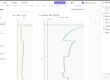
- Ductility: indirect checks on detailing (tension and compression reinforcement ratios in beams, simplified expressions with confinement for columns and walls) and direct check of the curvature ductility factor with the moment-curvature diagram, which accounts for stirrup confinement of the core and for the unconfined cover. Two constitutive laws for the confined core: parabola-rectangle on design values (§4.1.2.1.2.1) for comparison with the ductility demand, and Mander on mean values for the ultimate and first-yield curvatures to be used in non-linear (pushover) analyses.
- Serviceability limit states: normal stresses in uniaxial and biaxial bending with axial force (simplified or AAEM method), crack width according to the Eurocode and the Italian DM ’96, beam deflections with cracking, creep and shrinkage.
For existing buildings there is RC-SEC-FRP: sections strengthened with FRP (bending, shear, confinement), steel plating, collaborating slabs with computation of the slip to be taken by the connectors, RC jacketing, steel angle-and-strip caging; §8.4.1 checks and ductility before and after strengthening, with chord rotations θy and θu for pushover (§C8.7.2.3), also for prestressed sections.
The workflow on the foundation
- The foundation is modelled in Fondazioni CA (geometry, piles, layered soil with non-linear springs, loads and combinations from the superstructure).
- Internal forces, settlements (with group interaction at SLS) and the distribution of horizontal loads among the piles are read; for the piles the program designs and draws the reinforcement.
- The sections of beams, rafts and footings are checked in RC-SEC at the first-yield limit state for seismic combinations and at ULS and SLS for the others, with the interaction domains in the report.
- The calculation report comes out with assumptions, methods, code references (§7.2.2, §7.4, §4.1.2.1.2.1) and graphs: ready for filing.
Why the RC design “built into” geotechnical programs is not enough
Many geotechnical programs — GEO5 included — design the RC inside the wall, sheeting or pile calculation. It works for routine checks, but NTC 2018 asks something more of foundations: the first-yield moment instead of the ultimate moment in seismic combinations, curvature ductility where needed, group interaction in settlements, the kinematic moment in layered soils. These are checks that must be made explicitly and documented; Fondazioni CA and RC-SEC perform them in the form required by the Italian code.
Licences and trial
Both are desktop programs with a perpetual licence: Fondazioni CA €490 + VAT, RC-SEC €390 + VAT (RC-SEC-FRP €390), updates and support included for the first year and an optional yearly renewal equal to 10% of the list price. Online manuals: Fondazioni CA and RC-SEC. Free trial on request.
Frequently asked questions
It is the strength check required by NTC 2018 for the seismic combinations of foundation structures and of superstructures analysed as non-dissipative (§7.2.2): the resisting moment is not the ultimate one but the one in an essentially elastic range, corresponding to the lower of the curvature at steel yielding and the curvature at the concrete peak strain (0.002). RC-SEC performs it directly.
With linear or non-linear Winkler springs applied at the nodes of the discretised pile: hyperbolic p-y curves (Carter) for transverse deformations, t-z curves along the shaft and q-b curves at the toe for axial ones. The interaction between piles in a group for SLS settlements is computed with Lancellotta’s factors, the one for transverse loads with the p-y curves; Chin’s model uses load tests on trial piles; piled rafts are handled with the PDR method; the kinematic moment in two-layer soil with Gazetas (1997).
RC sections of any shape: rectangular, T, double-T, L and circular with fast input, generic polygonal sections with one or more solid or hollow domains, composite sections and bridge piers, also imported from DXF. ULS checks in uniaxial and biaxial bending with N-Mx-My domains, shear and torsion, buckling, first yield, curvature ductility with moment-curvature (also Mander), SLS with stresses, cracking and deflections; up to 60 combinations per type in one run.
Foundations are designed to remain elastic (non-dissipative behaviour) and in seismic combinations they are checked at the first-yield limit state; the ductility checks of §7.4 — indirect on detailing and direct with the curvature ductility factor — concern the elements that must dissipate. RC-SEC performs both families of checks and builds the moment-curvature diagram with stirrup confinement.
Fondazioni CA costs €490 + VAT and RC-SEC €390 + VAT (RC-SEC-FRP €390), with a perpetual licence: updates and support included for the first year, then an optional yearly renewal equal to 10% of the list price. A free trial is available on request.
Further reading
- Fondazioni CA · RC-SEC · RC-SEC-FRP · MP – piles and micropiles · DeepFound – piled rafts
- GeoStru or GEO5? Comparing the two geotechnical suites · The best software for geologists in 2026
- Request a free trial
Article updated in September 2026. Comments: info@geostru.eu.