You know how a singer holding a high note can crack a wine glass? Or how pushing a swing at just the right moment sends it higher and higher? It’s the same phenomenon: resonance. Every object has its own preferred “rhythm” — a frequency at which it vibrates most easily.
And the ground beneath our feet? It has its note too. It’s called the fundamental resonance frequency, written f0, and knowing it is one of the simplest and cheapest ways to understand how a site will respond to an earthquake. The tool that finds it is called HVSR.
How to “listen” to the ground
The ground is never completely still: wind, the sea, traffic and human activity make it vibrate imperceptibly all the time. This background is called ambient seismic noise (or microtremor). It means nothing to the ear; to an instrument, it means a great deal.
HVSR (Horizontal-to-Vertical Spectral Ratio, the Nakamura method) consists of recording that noise with a small three-component sensor — North-South, East-West and vertical — placed on the ground for a few minutes. Then you compare how much the ground vibrates horizontally versus vertically: that’s the H/V spectral ratio. No explosives, no drilling: just listening.
That curve with a peak
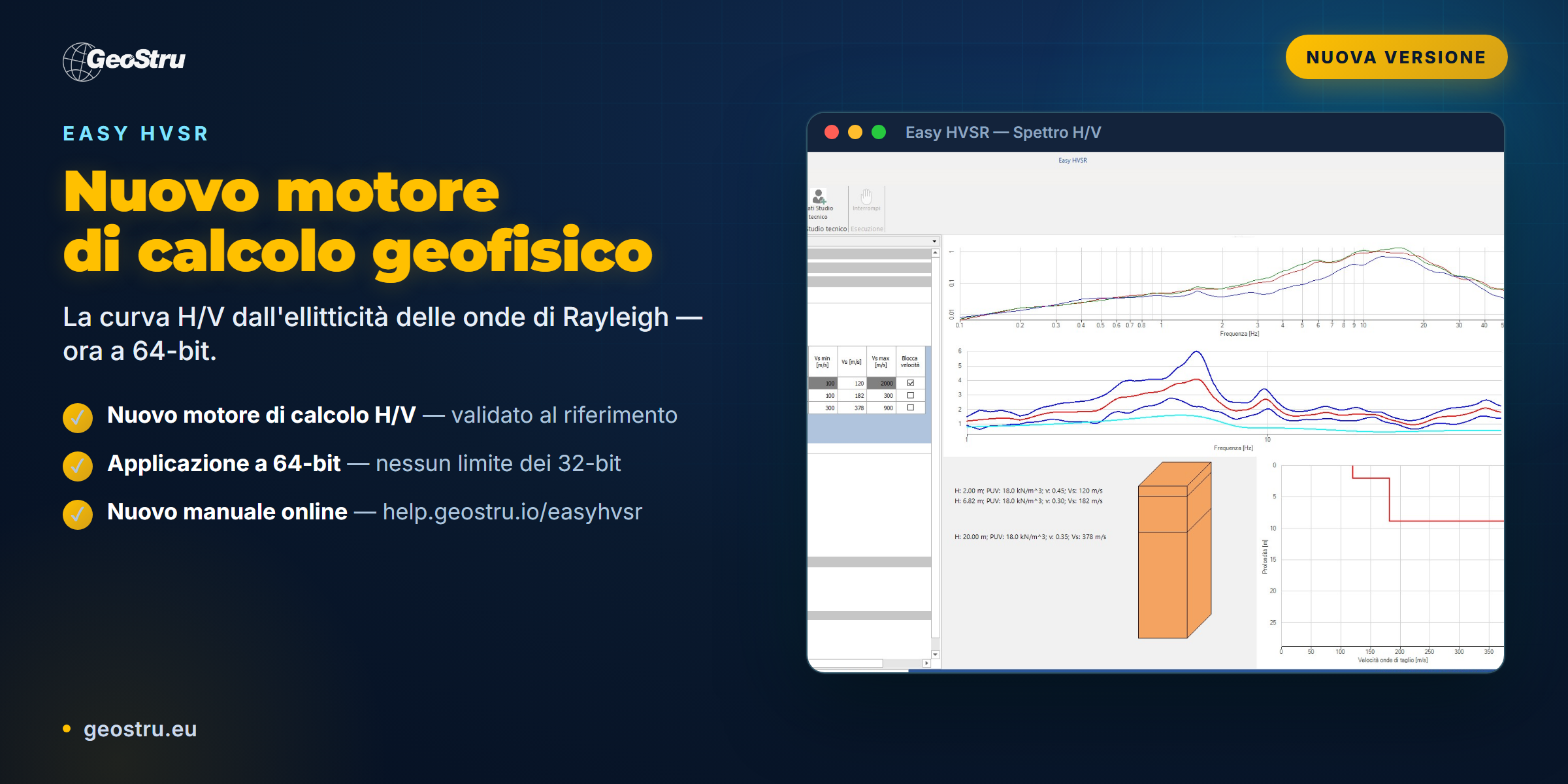
The analysis produces a curve: the H/V ratio as a function of frequency. At most sites that curve shows a clearly recognisable peak. The frequency at which the peak falls is precisely f0, the ground’s note.
And it already tells us a lot:
- a peak at high frequencies (several Hz) indicates thin cover over the stiff bedrock;
- a peak at low frequencies (fractions of a Hz) indicates thick cover;
- as a rough estimate, the thickness H of the cover is linked to f0 by the relation H ≈ Vs / (4·f0), where Vs is the shear-wave velocity in the surface soils.
In practice, by listening to the ground’s whisper for a few minutes you obtain information that would otherwise require far more invasive and expensive surveys.
Why f0 can “save” a building
Here comes the important part. A building also has its own natural frequency of oscillation. If the building’s frequency is close to the f0 of the ground it stands on, during an earthquake the two resonate together: the shaking is amplified and the structure is stressed much more. It’s the effect engineers call double resonance — and it explains why, for the same earthquake, similar buildings on different soils can behave very differently.
Knowing a site’s f0 therefore serves to:
- characterise the subsoil and estimate the Vs velocity profile;
- assess the risk of soil-structure resonance;
- feed the seismic microzonation studies required by regulations.
All of this starting from a passive, fast and non-destructive measurement.
From noise to result, in a few clicks
Turning that noise into a reliable f0 is exactly what Easy HVSR does. The workflow is linear and guided:
- Traces — import the recording (SAF, SEG-2, ASCII…);
- Selection — choose the “clean” time windows, discarding transients;
- Spectral analysis — smoothing (Konno-Ohmachi) and computation of the average H/V curve;
- H/V spectrum — read f0 and check the SESAME reliability criteria;
- (optional) inversion — estimate the subsoil Vs profile.
The computation engine is developed in-house at GeoStru and validated against the field’s scientific reference: same physics, reproducible results.
In short
Next time you hear about seismic risk, remember the ground’s note. It’s a small number — f0 — that holds a lot of information about what lies beneath our feet and how that ground will “sound” during an earthquake. And today, to find it, you just need to know how to listen.
Want to try it? Discover Easy HVSR: the full manual is at help.geostru.io/easyhvsr, with a quick-start guide designed even for those new to HVSR.