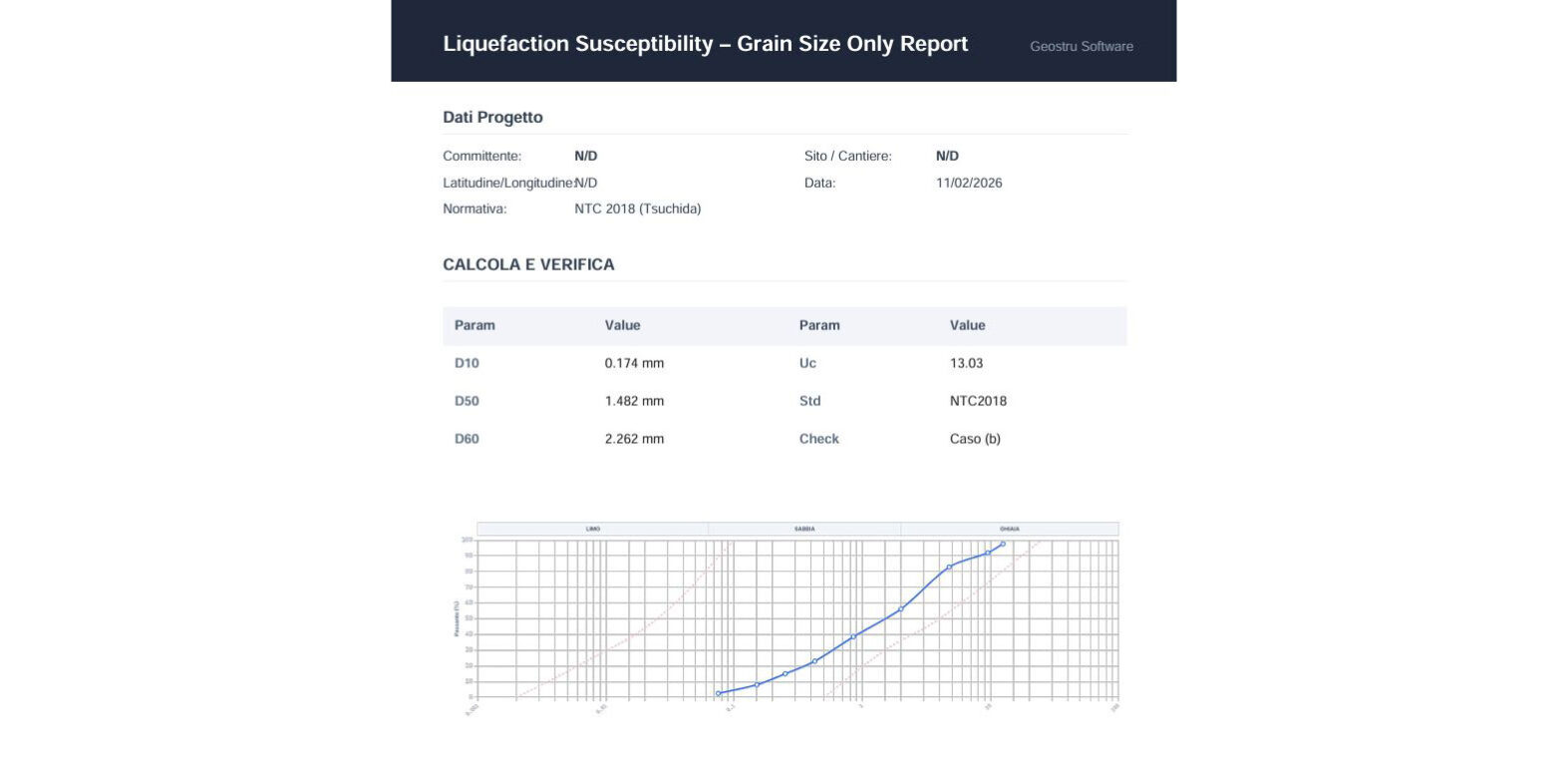
Soil liquefaction analysis represents a fundamental step in geotechnics to define soil behavior under seismic stress. In professional practice, grain size distribution is not merely a classification; it is the physical factor determining if a soil transitions from solid to liquid during an earthquake.
Why grain distribution controls soil liquefaction analysis
The risk depends directly on the physical arrangement of particles. When performing a technical evaluation on a laboratory sample, we look for specific signals in its composition:
-
Grain uniformity: a uniform distribution indicates high void ratios, which are critical.
-
Critical diameters: fine sands often trigger a positive response in a geotechnical study.
-
Fine fraction: small variations in clay content can significantly alter the results.
Regulatory standards for soil liquefaction analysis
Modern Eurocodes and international standards emphasize the importance of site-specific characterization. A rigorous study must account for the cyclic resistance ratio (CRR) compared to the cyclic stress ratio (CSR). This comparison is deeply influenced by the soil’s fine content and the mean grain size (D50), parameters extracted directly from the grading curve during the investigation phase.
Advanced software tools for geotechnical studies
To translate soil composition into safety parameters, professionals today use advanced digital tools. The specialized Liquefaction – Grain Size application is designed to simplify every soil liquefaction analysis by integrating laboratory results with seismic data and in-situ tests like CPT and SPT. Using professional software allows you to manage the Liquefaction Potential Index (LPI) with extreme precision.
Conclusions and operational perspectives
Ultimately, grain size distribution is the pillar upon which building safety rests. A correct soil liquefaction analysis allows for the design of targeted mitigation, such as soil compaction or gravel columns. By assessing the diameter of particles, engineers can increase infrastructure resilience through a detailed and professional analysis.