Filippo Catanzariti (b. 4 June 1969, Calabria, Italy) is a civil engineer, software developer and entrepreneur.
He graduated in Civil Engineering, geotechnical track, at the University of Calabria in 1996, with a thesis entitled "Programma di calcolo per l'analisi della stabilita dei pendii con metodi numerici avanzati" (A calculation program for slope stability analysis using advanced numerical methods) - the work that became his first commercial product. He has been registered with the Order of Engineers of Reggio Calabria (no. 1839) since 1996.
From 1996 to 1999 he worked as an analyst and software developer specialising in numerical algorithms, in Pascal, Visual Basic, Fortran and Visual C++, and in full-stack web development. He works with advanced 2D and 3D mathematical models and with graphics programming in OpenGL and DirectX.
In 1999 he founded GeoStru, an international geotechnical software house whose catalogue he largely authored: slope stability and rockfall analysis, foundations and retaining structures, finite element analysis, geophysics and site investigation, hydrology and hydrogeology, and reinforced concrete design. Since 2016 he has run SC Engsoft S.r.l. in Cluj-Napoca, Romania, and he is technical and scientific consultant to GoMeeting. His most recent work is GeoStru.ai, a platform delivering geotechnical and civil calculation through natural-language conversation while keeping the analysis itself on deterministic, auditable algorithms.
Between 2005 and 2013 he co-supervised degree theses at the University of Calabria and the Mediterranea University of Reggio Calabria. He teaches accredited professional-development courses for geologists and engineers under accreditation from the Italian Consiglio Nazionale dei Geologi.
His peer-reviewed work includes papers in Green World Journal (2021), Marine and Petroleum Geology (2022), Journal of Mediterranean Earth Sciences (2022), Geosciences (2024) and Bulletin of Engineering Geology and the Environment (2026), together with memorie at the XXVII and XXVIII Italian National Geotechnical Conferences. He co-authored "Terre rinforzate" (EPC Editore, 2023) and "Terrae Motus".
He has been a member of AGI, ISRM, ISSMGE and AGI-IGS since 2014, and holds a certificate from AGS (Association of Geotechnical & Geoenvironmental Specialists).
ORCID: 0009-0001-2495-6395 - Scopus Author ID: 57936189800 - Google Scholar: ZiY1VZUAAAAJ
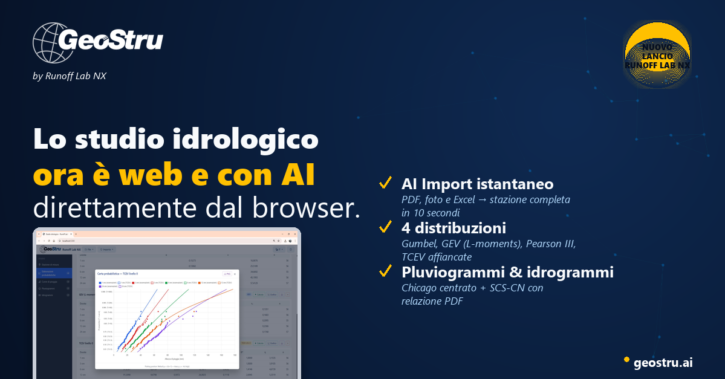
Runoff Lab NX brings the entire hydrological workflow to your browser — from the rainfall series to the flood hydrograph — and introduces AI Import: drop a yearbook PDF in, the artificial intelligence reads the document and populates the station in seconds. It’s the first web application of the new GeoStru NX suite. The analysis…
Integrare il BIM nella Geotecnica e nella Geologia. Come definito dal NIBS (National Institute of Building Sciences), il Building Information Modeling è “una rappresentazione digitale delle caratteristiche fisiche e funzionali di una struttura, una risorsa di conoscenza condivisa di informazioni che costituisce una base affidabile per qualsiasi decisione lungo il suo ciclo di vita, dalla…
If you are a professional in the field of geotechnics, you cannot afford to underestimate the importance of specialized software. Thanks to GeoStru, a leading company in the industry, you will have access to a wide range of free software tools that will allow you to optimize your activities, simplify processes, and improve the quality…
In the technical field it is important to document the works through photographic reports and geo-locate them on the map. The technology we have today allows you to easily get your position in real time. With few economic resources can get smartphones, tablets and PCs, equipped with GPS. Of course in the case of investigations…
We use technical cookies to run the site and, only with your consent, Google cookies to measure visits and our campaigns. If you decline, the site works just the same. Details.